



# 34254
[CAXTON, William, c. 1422 - c. 1491]; HIGDEN, Ranulf, c. 1280 - 1364 (
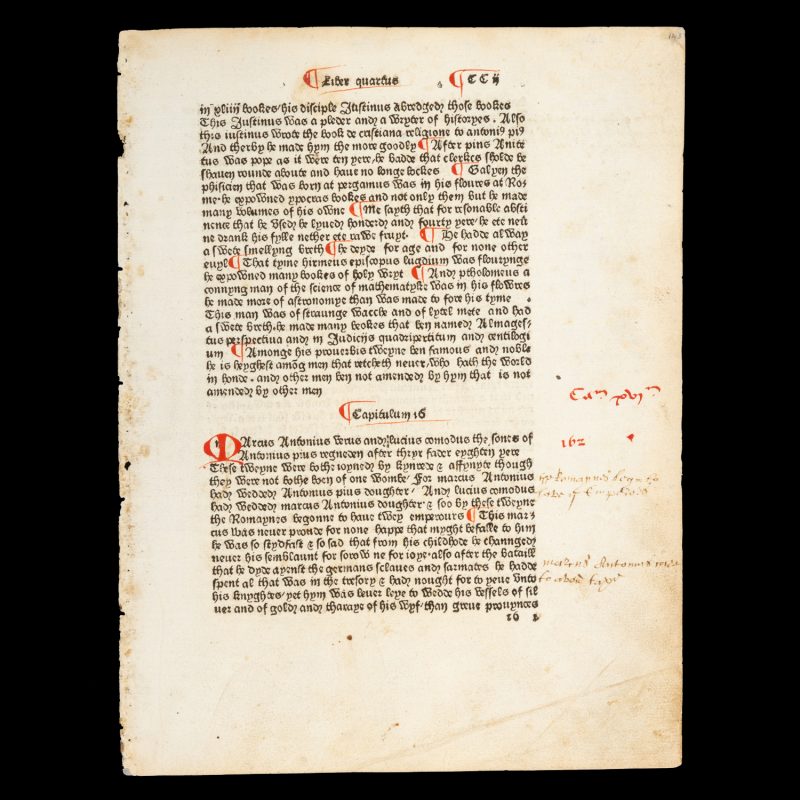
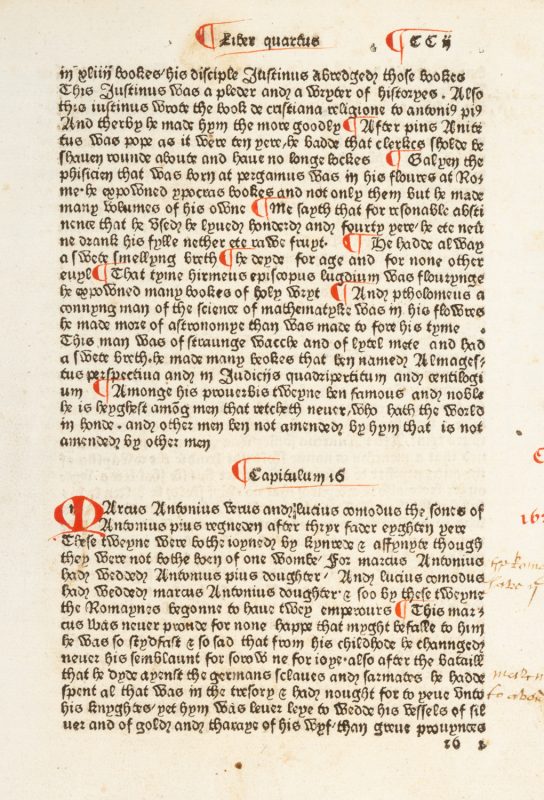
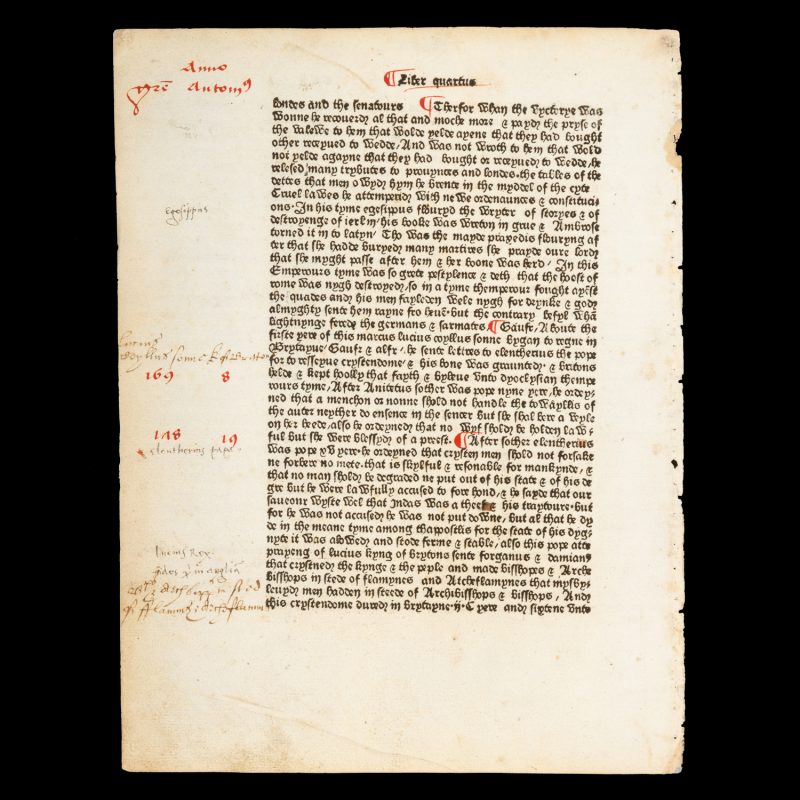
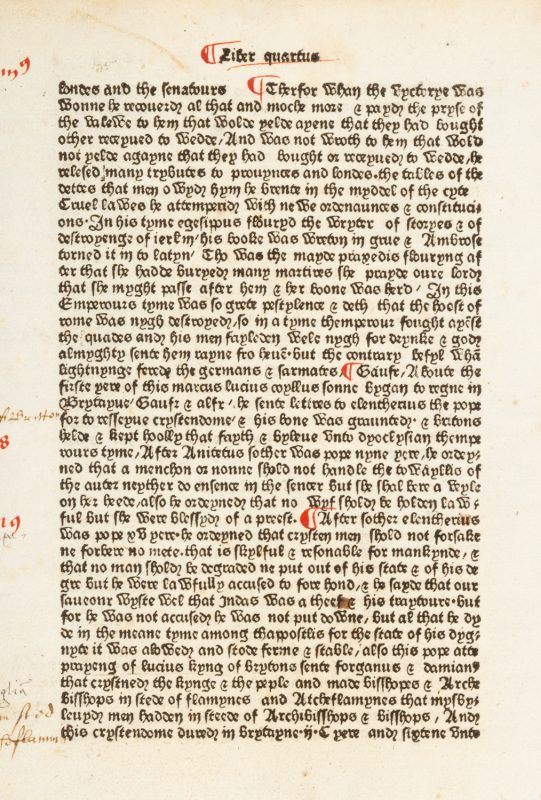
A leaf from William Caxton’s Polychronicon, printed in 1482.
$2,750.00 AUD
Westminster : William Caxton, between 2 July and 8 October 1482. Single leaf from Liber Quartus, f. CCii, 37 lines and headline (recto) and 40 lines and headline (verso), 274 x 206 mm (leaf), rubricated in red, with very early marginalia (several red inked notational marks likely done around the time of printing, and a number of annotations in brown ink in Middle English); faint diagonal crease at bottom corner, some light handling marks at fore-edge margin recto, else very good; unframed.
A fine specimen leaf from England’s first printer, William Caxton.
Born in Kent some time between 1415 and 1424, Caxton resided in London in the mid-1430s where he was apprenticed to a cloth dealer, Robert Large. Around 1445 he moved to Bruges and became a successful businessman and diplomat for King Edward IV. He later settled in Cologne where he translated Lefevre’s Recuyell of the Histories of Troy, and, after learning the art of printing, published it as a book in 1473-74. This was the first book printed in the English language. Caxton returned to England and set up a printing press at Westminster in 1476, where he printed Chaucer’s The Canterbury Tales, the first book printed in England.
Caxton went on to print over 100 early books, mostly in English, including the English translation by John of Trevisa (1342-1402) of Ranulf Higden’s Polychronicon, a universal history of the world from the Creation up to the year 1357, comprising seven books.
The single leaf offered here comprises the end of Chapter 15 and the first part of Chapter 16 of the fourth book, which deals with Justin Martyr and the joint reign of the Roman Emperors Marcus Aurelius Antoninus (the Stoic philosopher) and his adoptive brother Lucius Aurelius Verus (referred to by Higden as Marcus Antoninus Verus and Lucius Commodus respectively).


